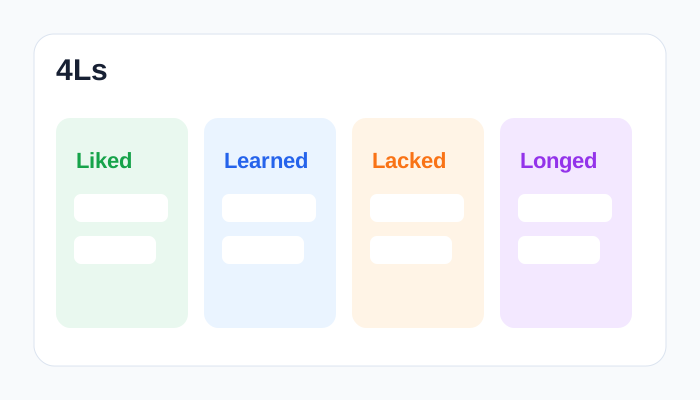
Some sprints leave the team with a useful lesson and a missing piece in the same story. The 4Ls keeps those observations separate: Liked protects what worked, Learned records discoveries, Lacked names missing support, and Longed For points to a better future.
Sprints with a lot of learning, project milestones, and teams ready to move past binary retro formats
What each column means
Use the prompts to keep cards specific. The examples show the level of detail that makes discussion and voting useful.
Liked
3
What helped, felt good, or worked well enough to repeat?
Daily pairing made unfamiliar code easier to change.
Narrowing the planning scope gave the team enough room to keep the sprint calm.
Customer feedback reached the team before implementation finished.
Learned
3
Which new fact, skill, assumption, or pattern did the team discover?
The cache invalidation path affects several services we had missed in our estimate.
Shorter demos brought sharper product feedback.
We identified the people who need to join accessibility reviews earlier.
Lacked
3
Which information, capability, block of time, named owner, or source of support was missing from the work?
The performance test lacked realistic data.
The cross-team dependency had nobody who could take clear ownership of it.
The story was missing a clear failure-state design.
Longed For
3
What did the team wish had existed, happened sooner, or worked differently?
One place to see rollout readiness.
Longer blocks of uninterrupted time for the team to work through the migration.
An earlier decision about the customer segment that mattered first.
30 to 40 minutes agenda
A complete path from framing the room to assigning one concrete follow-up.
01
Frame the period
Name the sprint, release, or project stage under review. Explain how a missing input in Lacked differs from a desired future condition in Longed For.
3 minutes
02
Write across all four Ls
Give everyone seven quiet minutes to add cards to all four columns. Keep each card to one specific moment or observation.
7 minutes
03
Share before solving
Read the cards one column at a time and allow brief clarifying questions. Hold debate and solutions until the team picks its priority themes.
6 minutes
04
Group related evidence
Cluster cards that describe the same pattern across different columns. A lesson may connect directly to something the team lacked.
5 minutes
05
Vote and discuss
Vote for the themes that had the biggest effect on team outcomes. Discuss the causes, tradeoffs, and changes the team could try next.
10 minutes
06
Protect and improve
Choose one behavior from Liked that the team can preserve. Add one small, owned experiment that addresses a theme from Lacked or Longed For.
5 minutes
Use this format when
This sprint included discovery, experiments, or unfamiliar work.
The team wants a deeper discussion after Went Well and To Improve has gone stale.
People need room for practical gaps and emotional reactions.
A project milestone deserves a full reflection that includes the work beyond delivery metrics alone.
Choose another format when
The group needs a fast check-in with one decision.
Participants need an explanation of Lacked and Longed For, but the session is too short to provide it.
A specific incident needs a factual timeline and a blameless review.
Facilitation tips
Define Lacked as a missing input or support. Longed For describes a desired future condition that the team can name in concrete terms.
Ask what the team learned about its system, customers, process, and itself.
Give the Liked column real attention and decide which successful conditions the team should protect in the next period.
Link cards across columns when one reveals the cause of another.
Finish with a small, owned experiment. Leave any remaining wishes for a separate conversation after the retrospective ends.
Useful variations
4Ls for a project milestone
Review a full project phase and ask which lesson should shape the next milestone plan.
Anonymous 4Ls
Collect anonymous cards when the team is discussing missing support, workload, or confidence in decision-making.
Customer-focused 4Ls
Write each card from a customer or user perspective. Look for customer value and learning, then name unmet needs and the outcomes customers still want.
Before the retro
Recommended warm-up
This or That
Use a quick, low-pressure choice round before the retrospective begins.
Liked covers positive experiences, Learned records new knowledge, Lacked names missing support, and Longed For describes a desired future condition.
What is the difference between Lacked and Longed For?
Lacked names missing inputs or support. Longed For describes an improvement or future condition the team wishes it had.
How long does a 4Ls retrospective take?
Plan for 30 to 40 minutes. That gives three to ten people time for quiet writing, grouping, voting, discussion, and choosing actions.
When is the 4Ls retrospective most useful?
Use 4Ls after a sprint full of learning, an experiment, or a milestone in a longer project. It also works when a positive-and-negative format has stopped producing useful insight.
Is it called a 4L or 4Ls retrospective?
Both names describe this format. The name 4Ls retrospective points directly to the four prompts: Liked, Learned, Lacked, and Longed For.
Related resources
Run this 4Ls retrospective
Open one shared board with Liked, Learned, Lacked, and Longed For ready. Choose the strongest theme and turn it into an owned experiment.