Retrospective templates
Ready-to-use template

Sailboat Retrospective

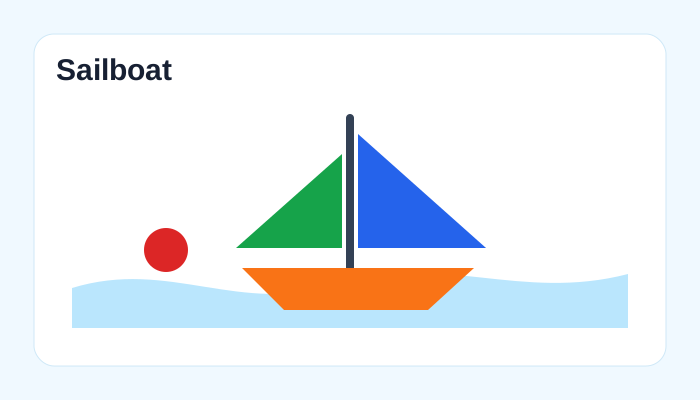
The Sailboat retrospective turns a sprint or project into a shared map. Teammates name what creates momentum, what causes drag, what could hurt progress next, and what success should look like.

Duration
35–45 minutes
Team size
3–12 people
Best for
Roadmap changes, delivery risks, and teams aligning around a goal
Sailboat retrospective template preview

What each column means

Use the prompts to keep cards specific. The examples show the level of detail that makes discussion and voting useful.

Column 1

Wind in Our Sails

What helped us move faster, collaborate better, or make confident progress?

Example cards

  • Pairing on the migration removed uncertainty early.
  • The product demo clarified the acceptance criteria.
  • Smaller pull requests reduced review time.

Column 2

Anchors

What repeatedly slowed the team or consumed more effort than it should?

Example cards

  • Waiting for test data blocked two stories.
  • Too many parallel priorities split attention.
  • Unclear ownership delayed release decisions.

Column 3

Rocks Ahead

Which risks, dependencies, or unknowns could damage the next stage of work?

Example cards

  • The vendor API limit may affect launch traffic.
  • Only one teammate understands the deployment path.
  • The next milestone depends on an unconfirmed legal review.

Column 4

Our Island Goal

What concrete outcome are we navigating toward, and how will we recognize it?

Example cards

  • Customers finish checkout without retrying.
  • The on-call team can diagnose failures in ten minutes.
  • The beta launches to twenty invited teams.

35–45 minutes agenda

A complete path from framing the room to assigning one concrete follow-up.

  1. 01

    Set the destination

    Name the sprint, project, or time period being reviewed and agree on the island goal before collecting cards.

    3 minutes
  2. 02

    Write silently

    Give everyone quiet time to add specific observations to all four columns. Ask for one idea per card.

    7 minutes
  3. 03

    Read and clarify

    Move through each column, letting authors explain cards briefly without starting the solution discussion yet.

    7 minutes
  4. 04

    Group and vote

    Combine duplicate themes and give each person a small number of votes for the anchors or rocks that matter most.

    5 minutes
  5. 05

    Discuss the strongest forces

    Discuss the top momentum, drag, and risk themes. Connect each theme back to the shared destination.

    10 minutes
  6. 06

    Choose one navigation change

    Create one owned action that strengthens the wind, lifts an anchor, or reduces a rock before the next review.

    5 minutes

Use this format when

  • The team needs to align around a product, release, or project goal.
  • Risks and dependencies matter as much as the sprint that just ended.
  • A standard positive/negative retro feels repetitive.
  • Leaders need a concise picture of momentum and exposure without dominating the discussion.

Choose another format when

  • The team has only fifteen minutes; the four-part metaphor needs time to unpack.
  • There is an active interpersonal conflict that requires direct, carefully facilitated conversation.
  • The destination is unknown and cannot be clarified before the session.

Facilitation tips

  • Define anchors as current drag and rocks as future risk so the two columns do not become duplicates.
  • Ask for observable examples instead of abstract labels such as communication or process.
  • Do not let the island become a list of output tasks; describe the user or team outcome.
  • Discuss at least one source of wind so the retro protects what is already working.
  • Turn the selected action into an owner, deadline, and check-in signal.

Useful variations

Remote Sailboat

Use silent writing, anonymous cards, and a timer. Reveal all cards together so faster typists do not frame the room first.

Release Sailboat

Set the island as the release outcome and use rocks for launch, compliance, operational, and adoption risks.

Team-health Sailboat

Treat wind and anchors as collaboration forces while keeping rocks focused on burnout, knowledge concentration, or staffing risk.

Before the retro

Recommended warm-up

Draw & Guess

Build creative energy before moving into the Sailboat metaphor.

Play the warm-up

Frequently asked questions

What are the four parts of a Sailboat retrospective?

Wind represents forces helping progress, anchors represent current drag, rocks represent future risks, and the island represents the shared goal or desired outcome.

How long should a Sailboat retrospective take?

Plan 35–45 minutes for a team of three to twelve. A shorter session can work when cards are collected before the meeting.

What is the difference between anchors and rocks?

Anchors are problems already slowing the team. Rocks are risks or unknowns that could cause trouble next. Keeping that time distinction prevents duplicate discussion.

When should a team use the Sailboat format?

Use it when the team needs to connect recent experience with a future destination, especially around releases, roadmap changes, dependencies, and delivery risk.

Related retrospective templates

Run this Sailboat retrospective

Open the template with all four columns ready, invite the team, collect cards, vote, and assign the navigation change before the meeting ends.