Use this format when
- Most of the process works, and the team wants a careful tune-up.
- Time or attention is uneven.
- Useful practices still help, though their current frequency or intensity leaves the team's work out of balance.
Some team processes are healthy overall and still feel out of balance. KALM gives the group four precise choices for that conversation: Keep, Add, Less, and More, each with a different kind of adjustment. Those choices help the team shift effort while preserving practices that already work.
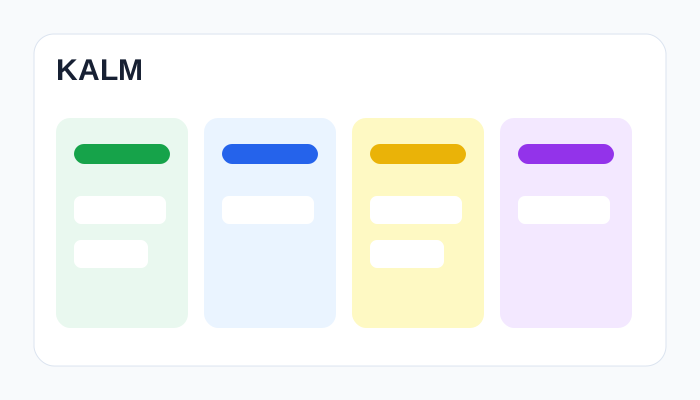
Use the prompts to keep cards specific. The examples show the level of detail that makes discussion and voting useful.
Which practices are working well at their current level?
Which missing capability or ritual would help the team?
Which useful activity is taking too much time or carrying too much weight?
Which useful practice needs extra frequency, depth, or attention?
A complete path from framing the room to assigning one concrete follow-up.
Name the sprint or project being reviewed, restate the purpose of each column, and remind everyone to describe observable events.
Give everyone uninterrupted time to add one specific observation per card across every column.
Read the cards column by column and let authors add context without debating solutions yet.
Combine cards that describe the same pattern, then vote for the themes that would most improve the next iteration.
Explore causes, consequences, and tradeoffs behind the highest-voted themes while making space for dissenting evidence.
Turn the strongest insight into a small action with an owner, deadline, and signal the team can review next time.
Use Less and More to examine where team time goes and which work adds cognitive load.
Pairing, meetings, handoffs, feedback, and decision participation.
Bring the four prompts to testing, observability, reviews, and defect prevention.
Before the retro

Begin with positive appreciation before discussing what to keep and amplify.
KALM stands for Keep, Add, Less, and More, the four choices available in the exercise. Each label gives the team a different way to adjust how it works.
Less keeps a useful practice in place while reducing its frequency, narrowing its scope, or lowering its cost. Stopping removes the practice completely.
Choose KALM when most of the team system works and time, effort, or attention needs rebalancing.
Name the behavior, desired amount or frequency, owner, experiment period, and success signal. Specifics turn a broad intention into an experiment the team can review.
Open the ready-made columns, invite the team, collect observations, vote, and leave with an owned improvement.