Retrospective templates
Ready-to-use template

WRAP Retrospective

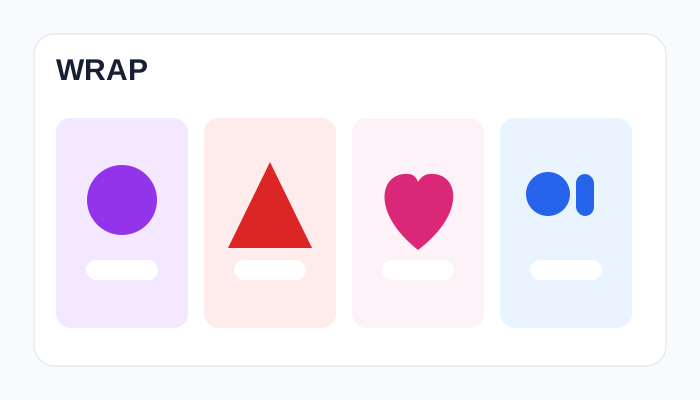
WRAP stands for Wishes, Risks, Appreciations, and Puzzles. It produces a broad picture when the team needs to look forward, recognize contribution, and expose uncertainty at the same time.

Duration
30–40 minutes
Team size
3–12 people
Best for
Project transitions, uncertain work, and balanced forward-looking reviews
WRAP retrospective template preview

What each column means

Use the prompts to keep cards specific. The examples show the level of detail that makes discussion and voting useful.

Column 1

Wishes

What do we hope will be different or possible next?

Example cards

  • I wish releases needed fewer manual checks.
  • I wish discovery reached engineers earlier.
  • I wish action items stayed visible.

Column 2

Risks

What could undermine delivery, quality, or team health?

Example cards

  • One person owns the migration knowledge.
  • The launch depends on an untested limit.
  • Support load may exceed capacity.

Column 3

Appreciations

Which contribution or behavior helped the team?

Example cards

  • Thanks for documenting the rollback.
  • Design tested the concept before build.
  • Ops explained the alert pattern clearly.

Column 4

Puzzles

What remains confusing, contradictory, or unknown?

Example cards

  • Why does review time spike on Fridays?
  • Which adoption signal matters first?
  • Why do estimates miss integration work?

30–40 minutes agenda

A complete path from framing the room to assigning one concrete follow-up.

  1. 01

    Frame the review

    Name the sprint or project being reviewed, restate the purpose of each column, and remind everyone to describe observable events.

    3 minutes
  2. 02

    Write observations silently

    Give everyone uninterrupted time to add one specific observation per card across every column.

    7 minutes
  3. 03

    Share and clarify

    Read the cards column by column and let authors add context without debating solutions yet.

    7 minutes
  4. 04

    Group and vote

    Combine cards that describe the same pattern, then vote for the themes that would most improve the next iteration.

    5 minutes
  5. 05

    Discuss the leading themes

    Explore causes, consequences, and tradeoffs behind the highest-voted themes while making space for dissenting evidence.

    10 minutes
  6. 06

    Commit to one change

    Turn the strongest insight into a small action with an owner, deadline, and signal the team can review next time.

    5 minutes

Use this format when

  • A project has meaningful uncertainty.
  • The team wants recognition without losing risk discussion.
  • A milestone transition needs forward-looking questions.

Choose another format when

  • The team needs a narrow process decision.
  • A puzzle requires private investigation before group discussion.
  • There is too little time to cover four different perspectives.

Facilitation tips

  • Keep Wishes within the team influence where possible.
  • Separate Risks from problems already happening.
  • Make Appreciations behavioral and specific.
  • Allow Puzzles to remain open when evidence is missing.
  • Assign an owner to investigate the selected puzzle.

Useful variations

Release WRAP

Scope wishes and risks to launch readiness, adoption, operations, and support.

Team WRAP

Focus on collaboration, skills, workload, and working agreements.

Async WRAP

Collect broad input ahead of time and use live time to connect risks with puzzles.

Before the retro

Recommended warm-up

This or That

Use a quick, low-pressure choice round before the retrospective begins.

Play the warm-up

Frequently asked questions

What does WRAP stand for in retrospectives?

WRAP stands for Wishes, Risks, Appreciations, and Puzzles.

What is a Puzzle in WRAP?

A Puzzle is an unresolved question or surprising pattern that needs more evidence before the team chooses a solution.

How are Wishes different from actions?

Wishes describe a desired future state; the team still needs to translate a prioritized wish into a small owned action.

When should a team use WRAP?

Use it for uncertain projects or transitions that benefit from aspiration, risk, recognition, and inquiry together.

Related retrospective templates

Run this WRAP Retrospective

Open the ready-made columns, invite the team, collect observations, vote, and leave with an owned improvement.