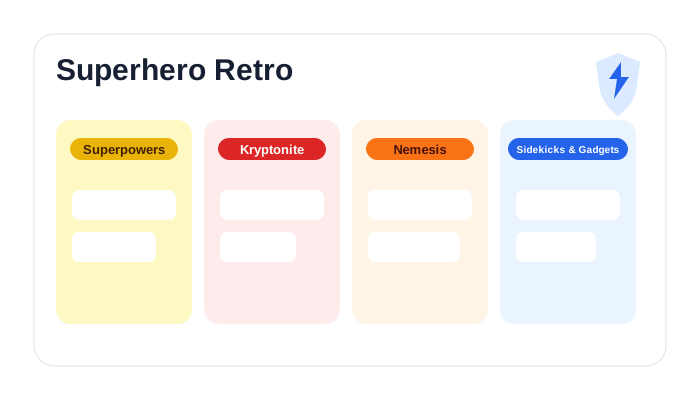
A playful metaphor can loosen up a serious conversation. In the Superhero retrospective, the whole team becomes one hero squad and looks at the powers it can rely on, the conditions that weaken it, the obstacles that keep returning, and the support that could change the next chapter.
New teams, milestone reviews, low morale, and a retrospective routine that feels stale
What each column means
Use the prompts to keep cards specific. The examples show the level of detail that makes discussion and voting useful.
Superpowers
3
Which repeatable skills, habits, or team qualities helped us succeed this time?
Pairing helped us untangle unfamiliar code fast.
Support shared customer context with engineering early, while the team still had time to use it in the decisions shaping the work.
Small releases kept the risk visible and reversible.
Kryptonite
3
Which conditions leave the team less effective or unusually exposed, especially when pressure rises and the work becomes harder to recover?
Unclear acceptance criteria send us back to restart work.
Interruptions break the focus we need for complex changes and force the team to rebuild its train of thought each time.
One person carries all the knowledge needed to diagnose the deployment pipeline.
Nemesis
3
Which obstacle or pattern keeps coming back, blocking progress across several pieces of work even after the team has dealt with it once?
Late scope changes keep destabilizing the sprint.
A slow vendor sandbox holds up end-to-end testing whenever the team reaches the point where its work needs to connect with the external system.
Unclear ownership delays decisions across teams.
Sidekicks & Gadgets
3
Which people, skills, tools, or support could help us overcome those obstacles?
A product partner who is available during refinement.
Production-like test data ready before implementation starts, covering the cases and volume the team expects to meet after release.
A shared release checklist with one named owner.
45–60 minutes agenda
A complete path from framing the room to assigning one concrete follow-up.
01
Introduce the hero squad
Set out the four prompts and frame the team as one hero squad. A Nemesis is an obstacle or recurring pattern. People stay out of that column.
5 minutes
02
Write the story silently
Give everyone eight quiet minutes to write specific observations from the sprint or milestone under review. Keep one idea on each card.
8 minutes
03
Reveal and clarify
Read the cards one column at a time. Ask each author for evidence or context, and save the solution debate for later.
10 minutes
04
Group and vote
Group cards that describe the same pattern, then vote for the Kryptonite or Nemesis that limits the team most.
6 minutes
05
Combine the powers
Take the highest-voted obstacle and discuss how an existing Superpower could work with a Sidekick or Gadget to reduce it during the next sprint or milestone, using evidence from the cards.
10 minutes
06
Choose one power-up
Write one small action with an owner, a deadline, and a signal the team can check next time.
6 minutes
Use this format when
A new or reshaped team needs language for how its strengths work together.
The team has come through a demanding sprint, release, or milestone.
A familiar positive-and-negative format has gone stale, and the same prompts keep leading the group back to the same conversation.
The team needs a comfortable way to ask for support.
Choose another format when
An active interpersonal conflict needs direct language and careful moderation from someone who can hold the conversation steady and protect the people involved.
The group lacks enough safety to name vulnerabilities together.
An urgent operational review would lose focus under the superhero metaphor.
Facilitation tips
Ask for evidence from the period under review and keep permanent personality labels off the board.
Treat the team as one hero squad. Keep individual rankings out of the exercise.
Use Kryptonite for a vulnerability and Nemesis for an obstacle that keeps returning.
Keep teammates and stakeholders out of the Nemesis column, even when a difficult interaction has become part of the pattern under discussion. Name the behavior, constraint, or system causing the trouble.
Build the final action around at least one Superpower the team already has.
Useful variations
Origin story
Trace each Superpower back to the challenge that helped the team develop it.
Hero squad
Let each person name one strength, then see how those powers combine into a capability the whole team can use.
Next-episode power-up
Use Sidekicks & Gadgets for one skill, tool, relationship, or experiment the team needs at the next milestone.
Before the retro
Recommended warm-up
Draw & Guess
Warm up the team's imagination before naming its collective superpowers.
A Superhero retrospective uses a hero-squad metaphor to uncover the team's strongest capabilities, vulnerabilities, recurring blockers, and support needs.
What are the Superhero retrospective columns?
The four columns are Superpowers, Kryptonite, Nemesis, and Sidekicks & Gadgets, which separate strengths, vulnerabilities, recurring obstacles, and the support the team can use.
What is the difference between Kryptonite and Nemesis?
Kryptonite is a condition that leaves the team vulnerable, such as a recurring interruption, a knowledge gap, or unclear acceptance criteria. A Nemesis is an obstacle or pattern that keeps blocking progress. A person never belongs in the Nemesis column, where the team should name the behavior, constraint, or system that blocks its progress.
How do you keep a Superhero retrospective useful?
Tie every card to work the team observed during the reviewed period. Celebrate the Superpowers, name the constraints plainly, and finish by pairing one power with one form of support against a priority obstacle.
Related resources
Run this Superhero retrospective
Open the four ready-made columns, bring in the hero squad, choose the obstacle that matters, and leave with one owned power-up.