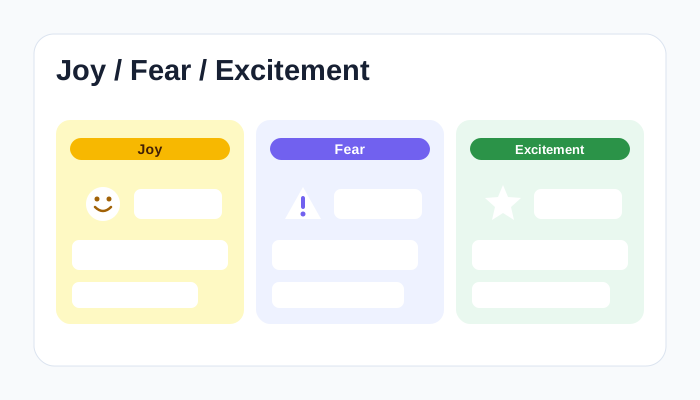
One release can leave a team proud of a clean recovery, worried about a fragile dependency, and eager to test a product idea. The Joy Fear Excitement retrospective template puts those reactions beside the work that caused them, so the team can protect what helped, reduce a credible risk, and explore a promising next move.
Release milestones, changing team energy, and work that carries both risk and possibility
What each column means
Use the prompts to keep cards specific. The examples show the level of detail that makes discussion and voting useful.
Joy
3
Which event, result, or team practice brought satisfaction, relief, pride, or connection during the period under review?
The rollback rehearsal worked on the first run, and two responders could complete it without waiting for the original author.
Support brought recent customer examples into refinement early enough for the team to remove an unnecessary workflow.
Finishing the migration before the code freeze gave us time to test recovery instead of rushing straight into release.
Fear
3
Which specific risk, uncertainty, or work condition concerns the team when it looks at the next sprint or milestone?
Only one engineer has restored the payment queue after a failed deployment.
The release still depends on a security review with no confirmed date or owner.
Late scope changes could crowd out the accessibility work again because that work has no protected capacity.
Excitement
3
Which opportunity, idea, or upcoming piece of work gives the team energy and deserves a closer look?
Test the new onboarding flow with two recent customers before the next planning session.
Try rotating demo ownership so more people can bring context directly to product and support.
The new deployment preview could let design review the finished states before a release reaches production.
35 to 45 minutes agenda
A complete path from framing the room to assigning one concrete follow-up.
01
Set the work boundary
Name the sprint, release, or project stage under review. Explain the three columns, ask for evidence from the work, and give everyone permission to pass on any prompt.
4 minutes
02
Write quietly
Give everyone uninterrupted time to add cards across all three columns. Keep one observation on each card, with enough detail for the team to understand the event, risk, or possibility.
7 minutes
03
Share the evidence
Read the cards one column at a time and invite brief context. Ask what happened, what effect people observed, or what makes a future concern credible.
7 minutes
04
Connect the themes
Group cards that point to the same part of the work. Look for a Joy worth protecting that could help the team reduce a Fear or pursue an Excitement card.
6 minutes
05
Choose where to act
Vote across the board, then discuss the leading themes. Compare the evidence, the effect on the next milestone, and how much control the team has over a useful response.
10 minutes
06
Make one response concrete
Choose one practice to protect, risk to reduce, or possibility to test. Give the response an owner, a review date, and a signal the team can observe.
6 minutes
Use this format when
A release, project stage, or team change has created a mix of confidence and concern.
The team wants to understand where its energy changed during recent work and which events caused that shift.
Planning needs to account for a real risk while preserving momentum around an opportunity.
A familiar process-focused retrospective has stopped surfacing the reasons people care about the work.
Choose another format when
People may feel pressure to reveal private emotions in front of leaders or teammates.
A serious incident needs a factual timeline, impact analysis, and a dedicated blameless review.
Harassment, discrimination, retaliation, misconduct, or an active personal conflict needs a private or formal process.
The group has no shared work period or milestone to anchor the conversation.
Facilitation tips
Treat the column names as prompts about the work. Nobody needs to explain their emotional history or share anything personal.
Ask for the event behind each reaction. A concrete card gives the team something it can protect, investigate, or change.
Keep Fear cards on risks, uncertainty, dependencies, and working conditions. Rewrite judgments about a person as observable behavior or a system condition.
Do not rush to reassure someone who names a concern. Clarify the evidence first, then ask which response would reduce the risk.
Give Joy enough discussion time to identify the conditions behind a good result. Those conditions may help with the next challenge.
Turn Excitement into one small test. Name what the team expects to learn and when it will look at the result.
Useful variations
Release readiness check
Review one upcoming release. Use Joy for proven strengths, Fear for readiness or recovery risks, and Excitement for the opportunities the release could open.
Project kickoff
Run the prompts as a futurespective. Bring useful experience into Joy, place credible delivery concerns in Fear, and collect the parts of the new work people want to explore under Excitement.
Private energy scan
Collect cards without visible authors when the board settings support it. Explain card visibility before writing begins, then discuss team-level patterns instead of asking who wrote each card.
Before the retro
Recommended warm-up
This or That
Use a quick, low-pressure choice round before the retrospective begins.
It is a three-column team reflection that connects rewarding work, credible concerns, and promising opportunities to specific events or conditions. The team uses those signals to choose a practical response.
What belongs in the Fear column?
Add a work-related risk, uncertainty, dependency, or condition that could affect the next sprint or milestone. Include the evidence behind the concern, such as a missing owner, an untested recovery path, or repeated late scope changes.
How is Joy Fear Excitement different from Mad Sad Glad?
Joy Fear Excitement looks at recent experience and the work ahead, with Fear and Excitement helping the team compare future risks and possibilities. Mad Sad Glad stays closer to emotional reactions to the period that just ended.
Do people have to share personal feelings?
No. Keep the prompts tied to events, decisions, results, and working conditions. Participants can pass, and nobody should be asked to explain a reaction beyond the work evidence they choose to share.
How long should a Joy Fear Excitement retrospective take?
Plan 35 to 45 minutes for three to twelve people. A larger board or a sensitive concern may need more discussion time, so protect the final six minutes for ownership and follow-up.
Related resources
Run this Joy Fear Excitement retrospective
Open the three ready-made columns, connect each reaction to the work, and choose one response with a clear owner and review date.