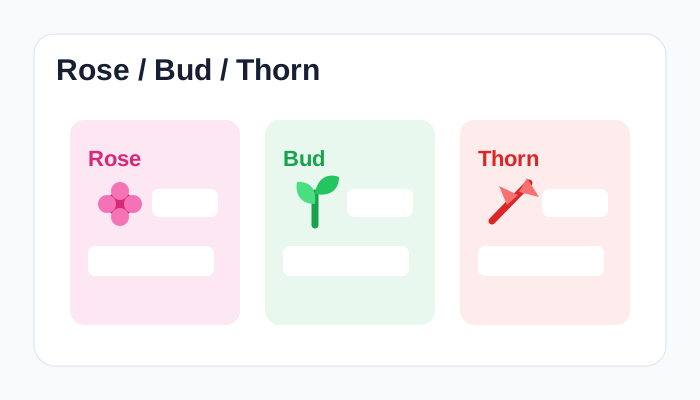
Some good ideas are still too young to count as wins. Rose Bud Thorn makes room for them. Rose holds what worked, Bud captures a promising signal that needs more evidence, and Thorn names the friction or risk the team needs to face.
Balanced retrospectives, early opportunities, and an easy-to-grasp reflection metaphor
What each column means
Use the prompts to keep cards specific. The examples show the level of detail that makes discussion and voting useful.
Rose
3
What worked well, helped the team, or deserves protection?
Pairing on the risky migration found edge cases before review.
Smaller release batches made the rollback decision clearer because the team could see exactly which changes belonged to each batch before choosing how to respond.
Support joined discovery early enough to correct an assumption.
Bud
3
What is starting to show promise, which evidence points in that direction, and what deserves a closer look during the next cycle?
The new demo format could bring customer feedback into planning sooner.
A shared on-call checklist has started to reduce repeated questions because responders can find the same steps without waiting for someone else to answer.
Two teams tried a shorter handoff and want to compare the results.
Thorn
3
What caused pain, added friction, created risk, or blocked progress in a way the team could observe during this sprint or project?
Unclear ownership left the production fix waiting overnight.
A late dependency change invalidated three finished stories and sent the team back through work it had already reviewed and accepted.
Review work piled up with one teammate at the end of the sprint.
30–40 minutes agenda
A complete path from framing the room to assigning one concrete follow-up.
01
Frame the reflection
Name the sprint, project, or experience under review, including the point where it began and the point where this reflection ends. Define Rose, Bud, and Thorn before anyone begins writing.
3 minutes
02
Write across all three sections
Give everyone seven quiet minutes to add specific observations. Keep one idea on each card, and invite contributions to every section.
7 minutes
03
Share and clarify
Read the cards one section at a time and let authors add brief context. Clarify the evidence, then save solution talk for the discussion.
6 minutes
04
Group connected patterns
Group related cards, including any pattern that connects a Rose worth protecting with a Bud or Thorn that could affect it.
5 minutes
05
Prioritize and discuss
Vote across the whole board, then discuss the themes with the greatest effect on team outcomes or the strongest learning potential. Give each person the same number of votes before discussion begins.
10 minutes
06
Protect, explore, and reduce
Choose one Rose to protect, decide if a Bud deserves a small experiment, and give someone ownership of reducing the leading Thorn.
5 minutes
Use this format when
The team wants a balanced review of strengths, opportunities, and difficulties.
A sprint or project produced promising early signals, and the team needs to decide which ones deserve evidence before they become a larger bet.
The usual went-well and improve prompts have stopped producing fresh conversation.
Product, design, and delivery need one shared structure that lets each perspective land on the same board before the group chooses what matters.
Choose another format when
An incident calls for a factual timeline, impact analysis, and blameless review process.
An active interpersonal conflict needs a private conversation or a skilled moderator who can keep the discussion direct and protect everyone involved.
The team understands the evidence and needs direct Start, Stop, and Continue decisions.
Facilitation tips
Reserve Bud for an emerging opportunity or a question worth exploring. Put committed work in the follow-up plan, where it can have an owner, a date, and a clear point for review after the session.
Write Thorns as observable events, constraints, or risks. Leave judgments about people off the board, and rewrite any personal label as the event, constraint, or risk the team actually observed.
Ask which evidence makes each Rose useful and each Bud promising.
Start with silent writing so every person frames their own experience before another voice sets the direction of the board for the whole group.
Discuss at least one Rose and name the conditions that helped it grow.
Keep the follow-up small: one Bud experiment and one clear response to the leading Thorn.
Useful variations
Product Rose Bud Thorn
Review customer evidence, product outcomes, emerging opportunities, and usability or delivery pain from one release.
Futurespective Rose Bud Thorn
Before a project begins, name the strengths to carry forward, possibilities worth testing, and risks that need an early response.
Async Rose Bud Thorn
Collect cards before the meeting and reveal them together. Save the live session for grouping, prioritization, and ownership.
Before the retro
Recommended warm-up
This or That
Use a quick, low-pressure choice round before the retrospective begins.
Rose Bud Thorn sorts observations into strengths, emerging opportunities, and difficulties or risks. Teams can use the same three labels to review an experience, idea, project, or period of work whenever they need a balanced view.
What do Rose, Bud, and Thorn mean in a retrospective?
Rose captures what worked or deserves protection, including the condition, behavior, or decision the team wants to carry into the next stretch of work. Bud holds something promising that needs more evidence or exploration. Thorn records pain, friction, risk, or a constraint the team should address, with enough detail for everyone to understand what happened.
What is the difference between a Bud and an action item?
A Bud is an emerging possibility that still needs evidence. Once the team chooses to explore it, the Bud becomes a small experiment with an owner and a review point.
How long should a Rose Bud Thorn retrospective take?
Plan 30–40 minutes for a team of three to twelve. Collecting cards asynchronously can shorten the live session and preserve enough time for the team to discuss the patterns, choose a response, and give that response an owner.
How should a team turn Rose Bud Thorn cards into actions?
Protect one condition behind a strong Rose, test one promising Bud, and assign an owner and check-in date for the Thorn the team most needs to reduce.
Related resources
Run this Rose Bud Thorn retrospective
Open Rose, Bud, and Thorn on one shared board, collect the evidence, choose the strongest pattern, and give the next step a clear owner.