Retrospective templates
Retrospective templates Updated

Plus Minus Interesting (PMI)retrospective template

Plus Minus Interesting slows down snap judgment. It separates clear benefits and drawbacks from surprising patterns, unresolved questions, and consequences the team is not ready to label yet.

Duration
30–40 minutes
Team size
3–10 people
Best for
Mixed evidence, experiments, and decisions where a simple pros-and-cons list loses important uncertainty
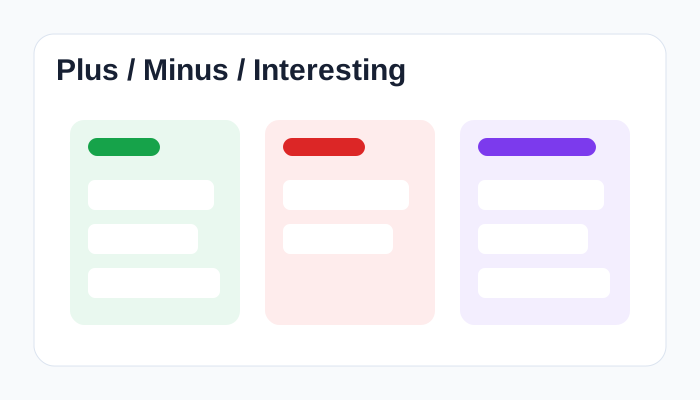
Plus / Minus / Interesting retrospective template preview

What each column means

Use the prompts to keep cards specific. The examples show the level of detail that makes discussion and voting useful.

Plus

3

What created value, reduced risk, or deserves to be protected?

  • Smaller releases made rollback decisions easier.
  • Pairing on the migration spread ownership across the team.
  • Early customer calls corrected the riskiest assumption.

Minus

3

What introduced cost, friction, delay, or risk?

  • The rollout checklist arrived after implementation started.
  • Review work concentrated with one teammate for three days.
  • The new alert created noise without a clear response owner.

Interesting

3

What surprised us, remains uncertain, or could change how we interpret the result?

  • Support requests fell, but only for customers using the new flow.
  • The faster build changed when people chose to run the full suite.
  • We do not yet know whether the improvement holds at peak traffic.

30–40 minutes agenda

A complete path from framing the room to assigning one concrete follow-up.

  1. 01

    Frame one subject

    Name the sprint, experiment, proposed change, or decision being evaluated and define the evidence period.

    3 minutes
  2. 02

    Collect Plus evidence

    Write benefits, strengths, and outcomes worth protecting. Ask for observable effects instead of general praise.

    5 minutes
  3. 03

    Collect Minus evidence

    Capture costs, friction, delays, and risks without debating solutions during collection.

    5 minutes
  4. 04

    Explore what is Interesting

    Record surprises, unknowns, second-order effects, and evidence that is not clearly positive or negative yet.

    6 minutes
  5. 05

    Group and prioritize

    Cluster related evidence and vote by impact or uncertainty rather than by the number of cards in each column.

    10 minutes
  6. 06

    Protect, reduce, investigate

    Choose what to preserve, what risk to reduce, and which unanswered question needs an owner and a next check.

    8 minutes

Use this format when

  • A sprint or experiment produced mixed or incomplete evidence.
  • The team is considering a meaningful process or product change.
  • A binary pros-and-cons conversation is hiding uncertainty.
  • Several disciplines need to compare different effects of the same decision.

Choose another format when

  • An incident requires a factual timeline and blameless incident review.
  • A sensitive conflict needs psychological-safety work before open evaluation.
  • The team already understands the issue and only needs direct habit choices; Start Stop Continue is clearer.

Facilitation tips

  • Keep Interesting distinct from a miscellaneous bucket: ask what is surprising, unresolved, or worth testing.
  • Give each column its own silent writing time so the first reaction does not dominate the board.
  • Ask for evidence and effects before opinions about whether a change was successful.
  • Vote across the whole board, using impact and uncertainty as separate lenses.
  • End with one protected strength, one reduced drawback, and one investigation owner.

Useful variations

Futurespective PMI

Evaluate a proposed change before committing: expected benefits, likely costs, and assumptions that still need evidence.

Experiment-review PMI

Compare results with an explicit hypothesis and use Interesting to capture side effects and unanswered questions.

Cross-functional PMI

Collect each discipline’s perspective separately, then group cards to expose shared effects and important differences.

Before the retro

Recommended warm-up

This or That icebreaker game preview

This or That

Use a quick, low-pressure choice round before the retrospective begins.

Play the warm-up

Frequently asked questions

What is Plus Minus Interesting?

Plus Minus Interesting, or PMI, is a structured evaluation method that separates benefits, drawbacks, and noteworthy unknowns or possibilities before a team reaches a conclusion.

What belongs in the Interesting column?

Interesting holds surprises, unanswered questions, neutral observations, second-order effects, and evidence that may change the decision but is not clearly positive or negative yet.

How is PMI different from pros and cons?

PMI adds a third space for uncertainty and curiosity. That prevents useful evidence from being forced into a positive or negative label too early.

Can PMI be used before making a decision?

Yes. A futurespective PMI can compare expected benefits, likely costs, and assumptions that need testing before the team commits.

How should a team turn PMI cards into actions?

Protect one high-value Plus, reduce one important Minus, and assign an owner and review point to the Interesting question that could most change the decision.

Run a Plus Minus Interesting retrospective

Open a board with Plus, Minus, and Interesting ready for the team, then turn mixed evidence into a focused next step.